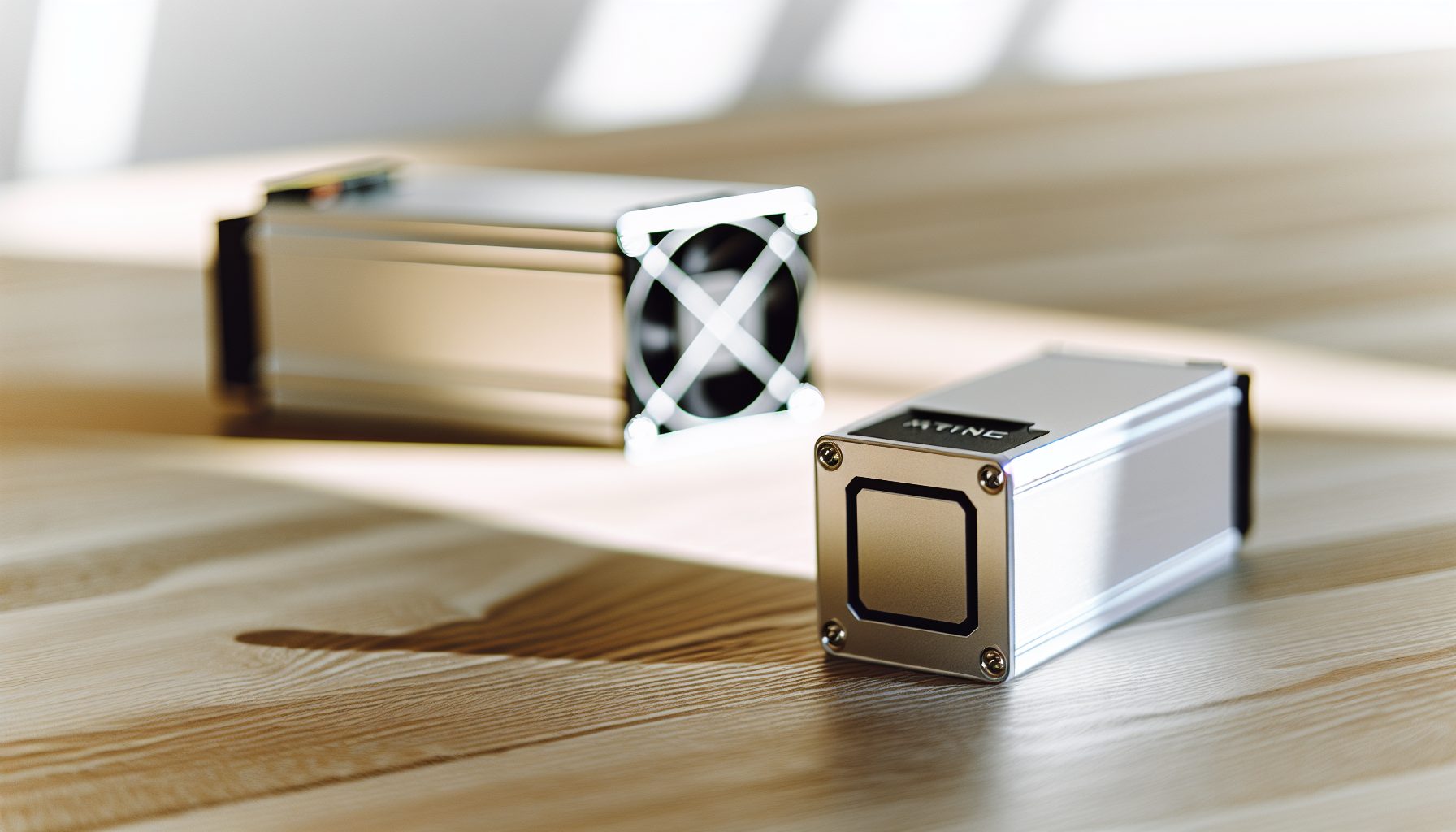
The Bitaxe Gamma 602 and NerdQaxe++ Rev 6.1 are the two most popular open-source solo Bitcoin miners you can get right now. Both run AxeOS, both use Bitmain’s BM1370 chip, and both let you take a shot at finding a Bitcoin block on your own. But they serve very different budgets and expectations.
This comparison breaks down exactly where each miner wins, where it loses, and which one makes sense for your situation.
TL;DR
Buy the Bitaxe Gamma 602 if you want the cheapest, simplest entry into solo mining with minimal power draw. Buy the NerdQaxe++ if you want 5x the hashrate and don’t mind higher power consumption and cost.
Side-by-Side Specs
| Spec | Bitaxe Gamma 602 | NerdQaxe++ Rev 6.1 |
|---|---|---|
| Hashrate | 1.2 TH/s | ~6 TH/s |
| Power Draw | 15–18W | ~80–100W |
| ASIC Chip | 1x BM1370 | 4x BM1370 |
| Efficiency | ~15 J/TH | ~16 J/TH |
| Connectivity | WiFi | Ethernet + WiFi |
| Firmware | AxeOS (open-source) | AxeOS (open-source) |
| Street Price | ~$99–$105 | ~$382–$418 |
| Cost per TH/s | ~$85 | ~$67 |
Price and Value: Cost per TH/s
The NerdQaxe++ wins the value argument on raw numbers. At roughly $400 for 6 TH/s, you’re paying about $67 per terahash. The Bitaxe Gamma 602 at around $100 for 1.2 TH/s comes in at roughly $85 per terahash.
So every dollar you spend on the NerdQaxe++ buys you about 27% more hashing power than the same dollar spent on the Gamma 602. If your primary goal is maximizing your odds of hitting a block per dollar invested, the NerdQaxe++ is the better buy.
But “better value per terahash” doesn’t tell the full story.
The Gamma 602’s total outlay is $100. The NerdQaxe++ is $400. That’s a real difference for someone who wants to dip a toe in solo mining without committing serious cash.
Real-World Performance Compared
Let’s be direct about what these hashrates actually mean against the current Bitcoin network.
As of February 2026, the Bitcoin network hashrate sits around 900 EH/s (900,000,000 TH/s). A block is found roughly every 10 minutes, which works out to about 144 blocks per day.
Bitaxe Gamma 602 at 1.2 TH/s:
Your share of the network is approximately 0.00000013%. Statistically, you’d expect to find one block every ~1,700 years. Your daily probability of hitting a block is roughly 0.00016%.
NerdQaxe++ at 6 TH/s:
Your share of the network is approximately 0.00000067%. Statistically, you’d expect to find one block every ~340 years. Your daily probability of hitting a block is roughly 0.00081%.
The NerdQaxe++ gives you 5x the odds of the Gamma 602. That’s a meaningful upgrade. But 5x a tiny number is still a tiny number. Solo mining at this scale is a lottery, full stop. The difference is whether you’re holding one ticket or five.
That said, solo miners do hit blocks. It happens more often than the statistics suggest because real-world variance is high. Someone always wins the lottery.
Power and Electricity Costs
Here’s the thing: one of the biggest practical differences between these two miners is how much they cost to run.
| kWh Rate | Gamma 602 Daily | Gamma 602 Monthly | NerdQaxe++ Daily | NerdQaxe++ Monthly |
|---|---|---|---|---|
| $0.10/kWh | $0.04 | $1.30 | $0.22 | $6.60 |
| $0.15/kWh | $0.06 | $1.95 | $0.33 | $9.90 |
| $0.20/kWh | $0.09 | $2.60 | $0.44 | $13.20 |
The Bitaxe Gamma 602 at 15–18W is essentially invisible on your electric bill. It draws less power than a laptop charger. You could run one for a full year at $0.15/kWh and spend about $23 on electricity.
The NerdQaxe++ at 80–100W is still modest by mining standards — it’s comparable to a bright incandescent light bulb — but it will show up on your bill. A year of operation at $0.15/kWh runs about $120.
Neither miner will break the bank on electricity, honestly. But if you live somewhere with expensive power ($0.30+/kWh), the NerdQaxe++ starts to feel less trivial at roughly $26/month.
Noise and Form Factor
The Bitaxe Gamma 602 is essentially silent. Its single BM1370 chip generates so little heat that the tiny onboard fan runs at low RPM or, in some configurations, barely spins at all. You can place it on a nightstand and sleep next to it without issue.
The device is roughly the size of a credit card — compact enough to tuck behind a monitor or mount on a wall.
The NerdQaxe++ is noticeably larger. With four BM1370 chips dissipating 80–100W of heat, it needs more aggressive cooling. The fan is audible — think a quiet desktop computer, not a jet engine. It won’t bother you in an office or living room, but you probably don’t want it in your bedroom. The form factor is still desktop-friendly, but it takes up more real estate than the Gamma and needs adequate ventilation around it.
If noise and size matter to you — and they often do for devices running 24/7 in living spaces — the Gamma 602 has a clear advantage.
Setup Difficulty
Both miners run AxeOS, which is the same open-source firmware. The setup process is nearly identical:
- Power on the device
- Connect to its WiFi access point
- Open the AxeOS web dashboard in your browser
- Enter your Bitcoin address and pool URL (typically public-pool.io or solo.ckpool.org)
- Start mining
Bitaxe Gamma 602: Plug in a USB-C power adapter, connect to WiFi, configure through the web interface. Total setup time: 5–10 minutes. It’s about as simple as setting up a smart home gadget. Any USB-C charger rated for 5V/3A will work — most modern phone chargers qualify.
NerdQaxe++ Rev 6.1: Same AxeOS interface, same configuration flow. The main difference is that the NerdQaxe++ supports Ethernet in addition to WiFi. For a device running 24/7, a wired Ethernet connection is more reliable and recommended. You’ll also need a beefier power supply — the NerdQaxe++ ships with or requires a barrel-jack PSU rated for its wattage. Plan to place it near your router or have an Ethernet cable ready.
If you’ve set up one AxeOS device, you’ve set up them all. The learning curve is identical. The NerdQaxe++ just has a slightly longer cable-management checklist.
Running Multiple Gammas vs One NerdQaxe++
Some buyers consider purchasing five Bitaxe Gamma 602 units instead of one NerdQaxe++. On paper, 5x 1.2 TH/s = 6 TH/s at roughly $500 — more expensive than the NerdQaxe++ for the same hashrate.
The multi-Gamma approach does have one upside: redundancy. If one unit fails, you still have four running. With the NerdQaxe++, a single failure takes you to zero.
But the downsides are real. Five devices means five power adapters, five WiFi connections to manage, and five dashboards to monitor. It also means five units drawing from the same WiFi network, which can cause congestion on cheaper routers.
For most people, one NerdQaxe++ is simpler, cheaper, and more space-efficient than a fleet of Gammas.
Who Should Buy the Bitaxe Gamma 602?
The Gamma 602 is for you if:
- You’re new to Bitcoin mining and want to understand how it works without a big financial commitment. Spending $100 to learn by doing is one of the better investments in Bitcoin education.
- You want the lowest possible running costs. At under $2/month in electricity, the Gamma is practically free to operate.
- You’re buying a gift or conversation piece. A small, silent, single-chip miner sitting on a desk is a solid way to introduce someone to Bitcoin.
- You want to stack multiple units. Some miners buy several Gamma 602s and run them in parallel. Four Gammas would roughly match one NerdQaxe++ in hashrate at a similar total cost, though with more devices to manage.
- Budget is the priority. $100 is a fundamentally different commitment than $400.
The Bitaxe Gamma 602 is an affordable open-source solo Bitcoin miner with 1.2 TH/s hashrate, silent operation, and minimal power draw at 15-18W.
Who Should Buy the NerdQaxe++?
The NerdQaxe++ is for you if:
- You’ve already tried solo mining with a Gamma or similar device and you’re ready to scale up your odds.
- You want the best hashrate per dollar. At ~$67/TH, the NerdQaxe++ is the most cost-efficient open-source solo miner available.
- You want a single, powerful device rather than managing multiple smaller ones. One NerdQaxe++ replaces five Gamma 602s.
- You prefer a wired connection. The Ethernet port gives you rock-solid connectivity for long-term unattended mining.
- You’re serious about the lottery odds. 6 TH/s doesn’t guarantee anything, but it gives you a meaningful upgrade over single-chip miners.
The NerdQaxe++ Rev 6.1 delivers 6 TH/s from four BM1370 chips with Ethernet and WiFi connectivity, offering the best cost-per-terahash in open-source solo mining.
Our Verdict
There’s no wrong choice here. Both are legitimate, open-source, community-supported miners built on the same platform.
The Bitaxe Gamma 602 is the better first miner. It’s cheap enough to be impulse-buyable, silent, and runs on practically nothing. If solo mining clicks for you, you can always upgrade later.
The NerdQaxe++ is the better second miner — or the right first miner if you already know what solo mining is and you’ve decided you’re in. It offers the best cost-per-terahash in the open-source solo mining category and packs serious power into a compact form factor.
Bottom line: if you can afford $400 and you’ve done your research, the NerdQaxe++ gives you more for your money. If you’re testing the waters, the Gamma 602 is the smarter starting point.
Where to Buy
Both miners are available from verified sellers. At the time of writing, Solo Satoshi has both in stock with same-day shipping on orders placed before 12 PM CST.
Buy Bitaxe Gamma 602 at Solo Satoshi
Buy NerdQaxe++ at Solo Satoshi
Always buy from verified sellers listed at bitaxe.org to avoid clones and counterfeit hardware.
Secure Your Winnings
If you hit a solo block, you’ll receive 3.125 BTC — worth over $200,000 at current prices. Don’t leave that sitting in a hot wallet. A hardware wallet is the only serious way to secure a windfall like that.
Ledger Hardware Wallets — Industry standard, supports Bitcoin and thousands of other assets.
Trezor Hardware Wallets — Fully open-source, Bitcoin-focused security.
Set up your hardware wallet before you start mining. You don’t want to scramble for security after you’ve already won.
The Ledger Nano X is an industry-standard hardware wallet supporting Bitcoin and thousands of cryptocurrencies with Bluetooth connectivity and secure chip technology.