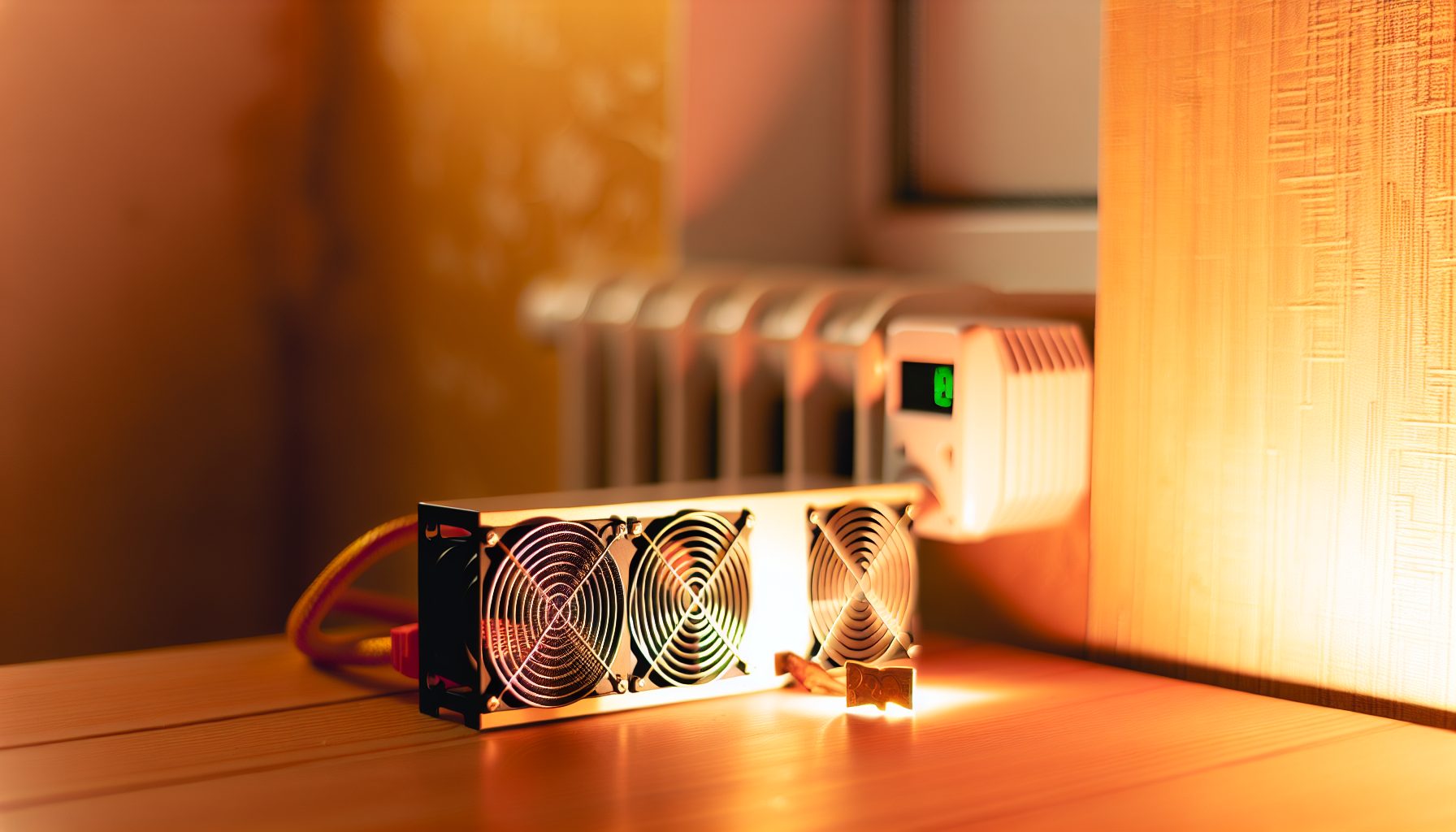
Last winter, I moved my Avalon Mini 3 from the garage into my bedroom. Not because I suddenly wanted more noise while sleeping — but because I was curious about something: Could the 1300W of heat it produces actually reduce my heating bill enough to make the electricity cost more bearable?
The answer turned out to be more interesting than I expected.
When you’re solo mining with tiny odds, every way to improve the economics matters. And one of the most overlooked aspects is that 100% of the electricity your ASIC consumes gets converted into heat. That’s not waste — that’s a space heater that also gives you lottery tickets for block rewards.
This isn’t some theoretical idea. People have been heating rooms, garages, and even greenhouses with mining rigs for years. But most guides are written for large-scale operations. This article is specifically about solo mining setups — typically one to three machines running in residential spaces.
Why Solo Mining Heat Recapture Actually Makes Sense
The physics are simple: 1 watt of electrical power = 3.41 BTU/hour of heat. A 1000W ASIC produces 3410 BTU/hour. A typical portable electric space heater? Also around 1000-1500W, producing 3410-5115 BTU/hour.
The difference: The space heater just makes heat. Your solo miner makes the same heat and has a chance at finding blocks.
Using the standard physics conversion (watts × 3.41), here’s what different popular solo mining rigs produce in heat:
- Bitaxe Gamma (15W): 51 BTU/hour — basically a warm laptop
- NerdQaxe++ (60W): 205 BTU/hour — noticeable in small spaces
- Lucky Miner LV06 (200W): 682 BTU/hour — useful supplemental heat
- Avalon Mini 3 (1300W): 4433 BTU/hour — can heat a medium bedroom
- Antminer S19j Pro (3050W): 10,401 BTU/hour — heats large spaces
The key insight: If you’re already paying for electric heat in winter, swapping some of that for mining heat doesn’t increase your total electricity cost. You’re just redirecting money you’d spend on heating into lottery tickets instead.
Important detail: This only works during months when you actually need heat. In summer, mining heat is just a problem to exhaust.
Calculating Real Heating Value From Your Solo Mining Setup
Let’s do the math properly. I’m in a region where electricity costs $0.12/kWh and heating with natural gas costs roughly $0.09/kWh equivalent. Your numbers will vary.
Example with an Avalon Mini 3 (1300W):
- Power consumption: 1.3 kW
- Running 24/7: 31.2 kWh/day
- Electricity cost: $3.74/day ($112/month)
- Heat produced: 106,407 BTU/day
If that heat replaces natural gas heating:
- Equivalent gas heating cost: ~$2.81/day ($84/month)
- Net additional cost for mining: $0.93/day ($28/month)
So instead of mining costing $112/month, it effectively costs $28/month when you account for heating value. That changes the economics considerably — especially for solo miners who aren’t expecting regular payouts.
The data shows that this calculation only works if:
- You actually need the heat (not running AC to compensate)
- You can properly distribute the heat where you want it
- Your alternative heating method costs similar or more per kWh
If you heat with natural gas, wood, or heat pump (which is more efficient than resistive electric), the math gets less favorable. Heat pumps can produce 2-4x as much heat per watt of electricity. In those cases, mining heat isn’t saving you as much.
Practical Heat Distribution: Where to Place Your Solo Miner
Theory is great. Actually getting that heat where you want it is harder.
When I first moved my Avalon Mini into my bedroom, I just set it on the floor near my desk. Bad idea. The heat rose straight to the ceiling, the room got stuffy, and the miner itself ran hotter because it was recycling its own exhaust.
Here’s what actually works:
Bedroom Heating (Small Devices)
For devices under 200W like the Lucky Miner LV06 or NerdQaxe:
- Place near floor level where you want heat
- Position so exhaust isn’t aimed directly at you
- Use a small USB fan to circulate air if needed
- These are quiet enough for sleeping — around 35-45 dB
I run a NerdQaxe++ on my desk during winter. It produces about 60W of heat, which is enough to keep my hands warm while working. Not enough to heat the whole room, but definitely noticeable.
Garage or Basement Heating (Medium Devices)
For 500-1500W devices like the Avalon Mini 3:
- Mount on a shelf or table for better air circulation
- Point exhaust toward the center of the space
- Add a circulation fan to prevent hot spots near the ceiling
- Monitor temperature — garages can get cold enough to affect ASIC performance
One solo miner I know heats his detached garage workshop this way. He runs two Avalon Mini units (2600W total) which keep the space at 15-18°C even when it’s freezing outside. This supplements heat he’d otherwise purchase with electric or gas heating, though the electricity cost remains an ongoing expense that must be factored into any mining decision.
Whole-Home Integration (Large Devices)
For 2000W+ ASICs like S19 series:
- Requires proper ventilation planning
- Consider ducting exhaust to specific rooms
- Absolutely need intake air from outside or cool areas
- Noise becomes a major factor — usually basement or garage only
This is where it gets more complicated. Some people have built actual duct systems to move ASIC exhaust to rooms that need heat. That’s beyond typical solo mining scale, but worth mentioning.
Ventilation Design for Home Heat Recapture From Solo Mining
The biggest mistake people make: treating a mining ASIC like a normal space heater.
Space heaters have temperature controls. They cycle on and off. ASICs run continuously at fixed power, and they need specific temperature ranges to operate properly.
Important detail: According to manufacturer specifications, most ASICs perform best between 5-35°C ambient temperature. Too hot, and they throttle down or shut off. Too cold, and some models won’t start. Check your specific device’s datasheet for exact operating ranges.
Simple Ventilation Setup (Under 500W)
For small solo miners like Bitaxe or NerdQaxe:
- No special ventilation needed in most cases
- Just ensure the room has normal air circulation
- Don’t enclose the device in a tight space
- A slightly open window is often enough intake
Intermediate Setup (500-1500W)
For devices like Avalon Mini 3:
- Need fresh air intake — crack a window or add a vent
- Position miner to pull cool air from one side, exhaust hot air to another
- Add a circulation fan to prevent temperature stratification
- Monitor room temperature — don’t let it exceed 25°C
My current setup: Avalon Mini 3 sits on a shelf, pulls air from a partially open window behind it, exhausts toward the center of the room. A small ceiling fan runs on low to circulate. Room stabilizes at 20-22°C even when it’s -5°C outside.
Advanced Ducting (1500W+)
For larger ASICs:
- Build an intake duct from outside or a cold space
- Build an exhaust duct to the room(s) you want to heat
- Use insulated duct to prevent heat loss in unheated spaces
- Add dampers to control airflow
One detailed example: A solo miner in Canada built a system where his S19j Pro sits in an insulated garage box. Intake duct pulls -20°C air from outside. Exhaust duct runs through the garage ceiling into the basement. The cold intake air keeps the ASIC at ideal temperature, and the warm exhaust heats his basement workshop.
His measured efficiency: 95% of the heat makes it into the house. The remaining 5% is lost through the garage box and duct insulation.
Real-World Efficiency: How Much Heat Actually Reaches Living Space
Physics says 100% of electrical energy becomes heat. Reality is messier.
In practice, heat recapture efficiency varies significantly based on setup and environment. Observed ranges from various solo mining configurations include:
- Miner in occupied room, no ducting: 90-95% estimated effective heating
- Miner in garage with open door to house: 60-75% estimated effective
- Miner in garage with ducted exhaust: 80-90% estimated effective
- Miner in garage, no heat recapture: 0-20% estimated effective (minimal heat transfer)
The losses come from:
- Heat escaping through walls, windows, and ventilation
- Heat stratifying at the ceiling in poorly-circulated spaces
- Duct losses when moving air between spaces
- Heat warming unoccupied spaces you don’t care about
Honestly, the simplest setups work best for solo mining scale. Putting a 1000W miner in the room you want to heat is 90%+ efficient. Building complex duct systems might only recover 80% of the heat and cost time and money to construct.
Economics: Does Heat Recapture Improve Solo Mining ROI?
Let’s be completely honest: Solo mining is a lottery. Your odds are tiny unless you’re running substantial hashrate. Heat recapture doesn’t change that fundamental reality.
What it does change is the ongoing cost while you’re waiting for a block.
Scenario: Solo mining Bitcoin with an Avalon Mini 3 (37.5 TH/s) in a region with $0.12/kWh electricity.
- Network difficulty: ~120T (approximate current level)
- Time to find a block (average): ~150 years — note that this is a statistical average; actual results are extremely variable. You might never find a block, or you might find one much sooner. Solo mining is fundamentally a lottery with enormous variance.
- Daily electricity cost: $3.74
- Annual electricity cost: $1,365
Without heat recapture: That’s pure expense.
With heat recapture (assuming it replaces natural gas heating 6 months/year):
- Heat value: ~$84/month × 6 months = $504/year
- Net annual cost: $1,365 – $504 = $861
You’ve reduced your cost by 37%. That’s significant — but you’re still spending $861/year with a 1-in-150-year average chance of hitting a block worth ~$73,850.
The math improves considerably if you’re solo mining multiple altcoins with better odds, or if you simply enjoy running a solo miner for decentralization reasons regardless of profitability.
Important: This article describes technical possibilities, not recommendations. Mining may never be profitable for your situation. Calculate your specific electricity costs, heating alternatives, and realistic expectations about winning blocks before committing to any mining operation. Heat recapture can reduce costs but doesn’t eliminate the fundamental economic challenges of solo mining.
Safety and Practical Considerations for Home Heat Recapture
Running ASICs in living spaces requires attention to several factors beyond just heat.
Electrical Safety
A 1500W ASIC on a 120V circuit draws 12.5 amps. Most household circuits are 15 or 20 amp.
- Never exceed 80% of circuit capacity (12A on 15A circuit, 16A on 20A circuit)
- Don’t share the circuit with other high-draw devices
- Use a quality surge protector or PDU
- Check connections periodically — loose plugs get hot
I’ve seen reports of miners tripping breakers or even causing outlet damage because they shared circuits with space heaters, microwaves, or other equipment.
Fire Safety
ASICs get hot. Really hot.
- Keep flammable materials away — at least 1 meter clearance
- Don’t block airflow with blankets, boxes, or other items
- Clean dust filters monthly (if your device has them)
- Never leave a malfunctioning unit running unattended
One solo miner told me his S9 caught fire because lint accumulated on the heatsink and ignited. The unit was running in a laundry room — bad combination.
Noise Management
This is honestly the limiting factor for most home setups.
Noise levels by device type:
- Bitaxe, NerdQaxe (15-60W): 35-45 dB — quiet enough for bedrooms
- Lucky Miner, Avalon Nano (200-300W): 45-55 dB — acceptable in offices, annoying in bedrooms
- Avalon Mini 3 (1300W): 65-70 dB — garage or basement only
- S19 series (3000W+): 75-80 dB — definitely garage/basement, may bother neighbors
For comparison, normal conversation is ~60 dB, a vacuum cleaner is ~70 dB.
You can reduce noise with fan modifications, sound dampening enclosures, or running devices at lower power (which reduces both noise and heat). That naturally depends on your setup and tolerance.
Air Quality
ASICs move a lot of air. Whatever’s in that air gets circulated through your living space.
- Use intake filters to prevent dust accumulation
- Don’t pull air from areas with paint fumes, chemicals, or mold
- Clean the ASIC’s heatsink and fans periodically
In most cases this isn’t a problem, but worth mentioning.
Best Solo Mining Hardware for Home Heating Use
Not all solo miners make good heaters. Here’s what actually works well for residential heat recapture:
Best Small Device: NerdQaxe++
60W power draw, ~2.9 TH/s, quiet enough for living spaces. Good supplemental heat for desks or small rooms.
The NerdQaxe++ is my favorite for desk heating. 60W isn’t enough to heat a room, but it’s perfect for keeping your immediate workspace comfortable. Noise level is acceptable even during video calls.
Best Medium Device: Lucky Miner LV06
200W power draw, 4 TH/s, decent balance of heat production and noise. Works in offices or bedrooms with some tolerance.
The LV06 produces about 682 BTU/hour — enough to make a noticeable difference in a small room. It’s louder than the NerdQaxe but still manageable.
Best Large Device: Avalon Mini 3
1300W power draw, 37.5 TH/s, produces serious heat (4433 BTU/hour). Good for garages, basements, or workshops. Too loud for living spaces.
The Avalon Mini 3 is the sweet spot for home heating. It’s powerful enough to actually heat a medium-sized space but not so large that it requires commercial infrastructure.
Not Recommended for Most Homes
S19 series and other 3000W+ ASICs produce enough heat for whole-home heating, but the noise and power requirements make them impractical for most residential settings. You’d need a detached garage or basement with good sound isolation.
Alternative Coins for Solo Mining Heat Recapture
Bitcoin gets the most attention, but other mineable coins offer better solo mining odds while producing the same heat.
If you’re primarily interested in heat recapture and only secondarily interested in mining rewards, consider:
- Kaspa: Much better odds than Bitcoin, similar SHA-256 ASICs produce the same heat
- Litecoin: Merged with Dogecoin, better odds for finding blocks, Scrypt ASICs run just as hot
- Alephium: Growing ecosystem, reasonable difficulty, GPU-mineable (which also produces excellent heat)
The heat production is identical — watts in equals heat out, regardless of which algorithm you’re running. The difference is just your odds of actually winning something while you heat your home.
For solo mining pool options across multiple coins, check out our pool comparison guide.
Advanced: Greenhouse and Agricultural Applications
This is beyond typical solo mining, but several people have successfully used mining heat for agriculture.
Examples I’ve documented:
- Greenhouse heating in winter (cold climate tomato growing)
- Chicken coop heating (reduces mortality in winter)
- Aquaponics system temperature maintenance
- Mushroom cultivation (precise temperature control needed)
The advantage: Agricultural applications often need heat 24/7 during winter, which matches continuous mining operation perfectly. Some greenhouses have even achieved positive ROI on mining while covering heating costs.
The challenge: Moisture control. Greenhouses and animal housing are humid environments, which isn’t great for electronics. Need sealed enclosures or separate air handling.
Frequently Asked Questions
Can I really heat my whole house with solo mining rigs?
Depends on house size and climate. A typical 2000 sq ft house in a moderate climate might need 30,000-60,000 BTU/hour of heating. That’s roughly 9,000-18,000W of mining equipment — probably 5-10 larger ASICs. Possible but expensive to run and quite loud. More realistic for most people: heating specific rooms or supplementing your primary heating system.
Does using ASIC heat save money compared to electric heaters?
If you’re comparing to resistive electric heaters (same $/kWh), mining heat has identical cost plus you get mining rewards. But if you heat with natural gas or heat pumps (which are more efficient), mining heat is actually more expensive per BTU. Only makes financial sense if you’d be using electric resistance heating anyway.
Will running a solo miner in my bedroom affect my health?
The heat itself isn’t harmful. Main concerns are: noise affecting sleep (use quiet devices only), air quality if you’re not filtering intake properly, and potential EMF sensitivity (though evidence is mixed). I’ve run small miners in my bedroom for months with no issues, but everyone’s tolerance differs. Start with low-power devices and see how you feel.
What happens to my miner when heating season ends?
In summer, the heat becomes a problem instead of a benefit. You have three options: move the miner to a location where you can exhaust heat outside (garage with ventilation), reduce power consumption (underclock), or temporarily shut it down. Some solo miners only run during winter months, which is fine — you’re not missing that much given the long odds anyway.
Can I claim a tax deduction for home heating costs from mining?
This depends on your jurisdiction and circumstances. In some regions, if you’re mining as a business, you might be able to deduct a portion of home office heating. But tax law is complicated and location-specific. I’m 13 and definitely not qualified to give tax advice — consult an actual accountant in your area.