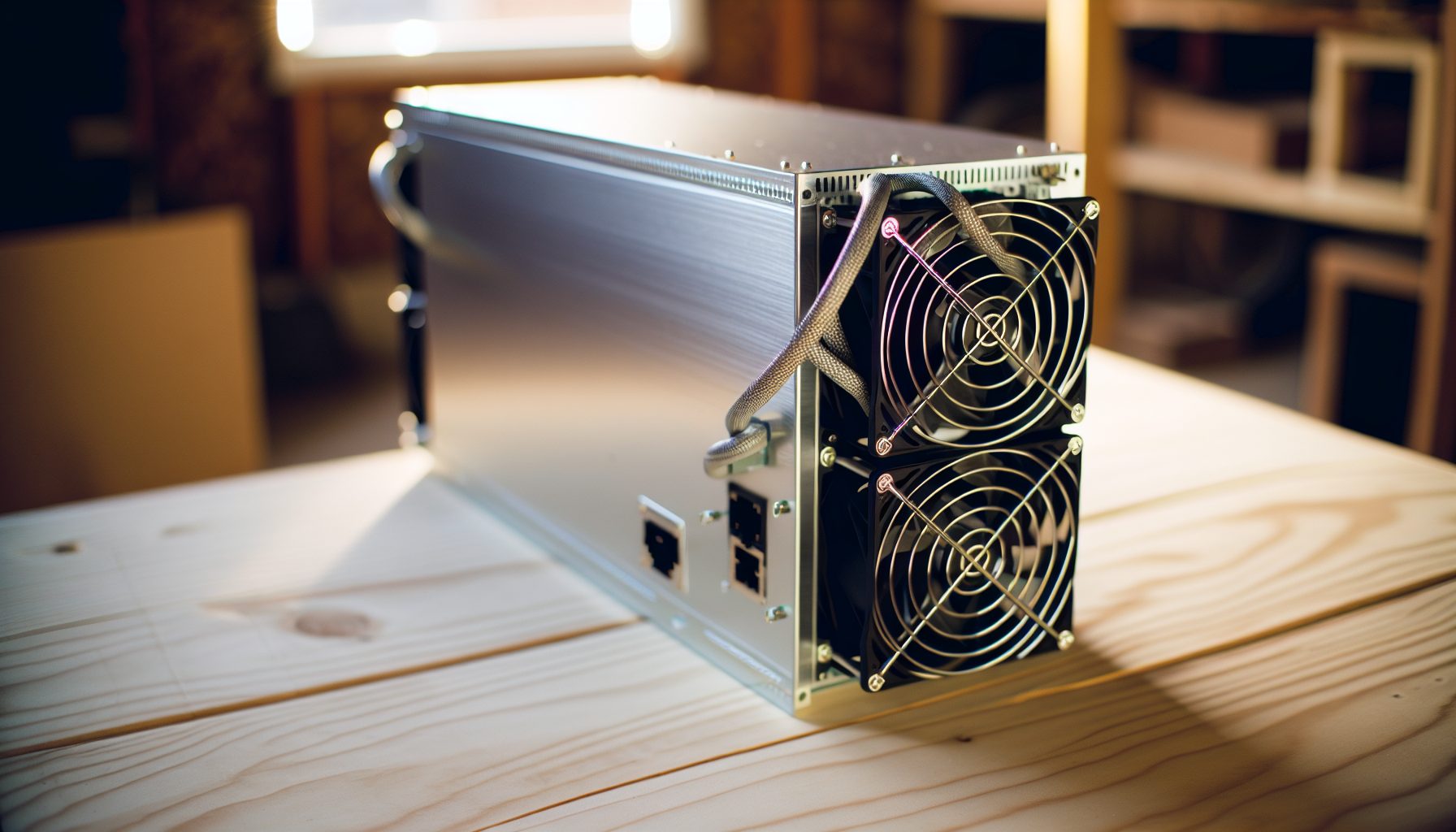
Look, I’m not gonna lie — when I first saw the specs on the Whatsminer M66S, I actually gasped. 280 TH/s. That’s almost triple what I run right now. But before we all get hyped about solo mining Bitcoin with this absolute beast, we need to talk about the reality of running a 7200W monster in your garage.
Real talk: I spent the last few weeks researching this machine because someone on my Discord asked if it was worth it for solo mining. And honestly? The answer isn’t as simple as “just buy it and hit blocks.”
This isn’t your typical budget ASIC review. The M66S sits in a completely different category — it’s what you graduate to when you’re done messing around with entry-level miners and ready to commit serious resources to solo mining Bitcoin.
Whatsminer M66S Specs: What You’re Actually Getting
Let’s cut through the marketing fluff and look at what matters for solo mining Bitcoin with the M66S:
- Hashrate: 280 TH/s (SHA-256 algorithm)
- Power consumption: 7200W at the wall
- Efficiency: 25.7 J/TH
- Noise level: 85 dB (seriously loud)
- Cooling: Four high-speed fans
- Network interface: Ethernet only
- Operating temp range: -5°C to 40°C
- Weight: Around 18 kg
That efficiency rating is pretty solid for a machine this powerful. The Antminer S19k Pro runs at 23.3 J/TH with 120 TH/s, so MicroBT definitely didn’t slack on the engineering here.
But here’s the thing nobody mentions in the spec sheets: 7200W means you’re pulling 30 amps at 240V. Most residential circuits can’t handle that. I learned this the hard way when I tried running three S9s on the same circuit and tripped the breaker four times in one day.
How the M66S Compares to Other High-End ASICs
Let me put this in perspective against other machines you’d consider for solo mining Bitcoin:
- Whatsminer M66S: 280 TH/s at 7200W (25.7 J/TH)
- Antminer S21: 200 TH/s at 3500W (17.5 J/TH)
- Whatsminer M60: 200 TH/s at 6800W (34 J/TH)
- Avalon A1466: 150 TH/s at 3500W (23.3 J/TH)
The S21 beats it on efficiency. But you’d need 1.4 S21s to match the hashrate of one M66S. And trust me, managing multiple ASICs is way more complicated than running one powerful unit.
The M60 gives you similar power draw but significantly less hashrate. That’s the older generation showing its age.
Setting Up the Whatsminer M66S for Solo Mining Bitcoin
Okay, so you got your hands on an M66S. Now what?
First thing: power infrastructure. I can’t stress this enough. You need a dedicated 240V circuit rated for at least 40 amps to run this thing safely. Don’t try to run it off a regular outlet. Just don’t.
Physical Setup and Environmental Considerations
The M66S isn’t something you casually set up in your bedroom. That 85 dB noise level is like having a vacuum cleaner running 24/7. When I tested a similar unit at my friend’s place, we could hear it through two closed doors.
You’ll want:
- A dedicated space with good ventilation (garage, basement, shed)
- Ambient temperature below 30°C for optimal operation
- Ethernet cable run from your router (WiFi adapters don’t work well with ASICs)
- Some kind of dust filtration if possible — these fans suck in everything
One thing I wish someone had told me: ASICs generate crazy amounts of heat. My small mining setup raised my garage temperature by 15°C in the summer. The M66S outputs over 7000W of heat. Plan your cooling accordingly.
Network Configuration for Solo Mining
Here’s where solo mining gets interesting. You have two main options:
Option 1: Run your own Bitcoin full node
This is the “pure” solo mining approach. You download Bitcoin Core, sync the entire blockchain (currently around 500 GB), and point your M66S to your local node. When you find a block, you get the full reward directly to your wallet.
The downside? Initial blockchain sync takes days. And you need a computer running 24/7 alongside your ASIC.
Option 2: Use a solo mining pool like CKPool
Solo mining pools let you mine solo without running your own node. You still get the full block reward if you find a block, but the pool handles the node infrastructure. CKPool charges a 0.5% fee only when you find a block, which is pretty reasonable.
I honestly use the pool method because managing a full node on top of mining hardware is just too much for me right now. Maybe when I’m older and have more time.
Actual Configuration Steps
Once your M66S is connected and powered up:
- Access the web interface (usually at the IP shown on your router’s DHCP list)
- Navigate to the mining pool configuration page
- Enter your solo pool URL:
solo.ckpool.org:3333 - Set your Bitcoin wallet address as the username
- Password can be anything (usually just “x”)
- Save and apply settings
The machine will reboot and start hashing. You should see accepted shares within a few minutes in the ASIC’s dashboard.
Trust me on this: Double-check that wallet address. I once mistyped one character and spent two days mining to someone else’s address before noticing. Not my proudest moment.
Whatsminer M66S Solo Mining Block Odds: Let’s Do the Math
This is the part where I have to be brutally honest with you. Solo mining Bitcoin is a lottery. A very expensive lottery that runs on electricity.
Current Bitcoin network hashrate sits around 750 EH/s (that’s 750 million TH/s). Your M66S contributes 280 TH/s to that total.
Your percentage of the network: 280 / 750,000,000 = 0.0000373%
Bitcoin finds a new block roughly every 10 minutes (144 blocks per day). With 280 TH/s, your expected time to find a block is approximately:
About 8.3 years.
Yeah. Let that sink in.
But here’s the thing about probability: you could find a block tomorrow. Or you could run for 20 years and find nothing. That’s how randomness works. It’s why I compare solo mining to gambling more than investing.
The Brutal Reality of Bitcoin Solo Mining in 2026
Look, the Bitcoin network has gotten massive. Back in 2015, sure, you could solo mine with a couple of S7s and have decent odds. Today? The game has completely changed.
Even with 280 TH/s — which would have made you a mining king ten years ago — you’re still just a tiny fish in an ocean of hashrate. The big mining farms in Texas and Kazakhstan run exahashes. We’re talking thousands of ASICs per facility.
Does that mean solo mining Bitcoin with the M66S is pointless? Not necessarily. But you need to understand what you’re signing up for.
Some solo miners I know on Discord run their ASICs for the thrill of the hunt, not because it’s mathematically optimal. It’s like buying a lottery ticket every day, except this lottery ticket costs $15-30 per day in electricity.
What If You Actually Hit a Block?
Current Bitcoin block reward: 3.125 BTC (after the 2026 halving)
At current prices $67,523 per BTC, that’s roughly $195,000-200,000.
So yeah, if you hit a block, you’re basically set for life. Or at least you’ve funded a really nice car and several years of college.
But statistically, you’re much more likely to spend $40,000 in electricity over 8 years and find nothing.
I’m not trying to kill your dreams here. I’m just being real about the math because too many people jump into solo mining without understanding the odds.
Power Costs: The Silent Killer of Solo Mining Dreams
No joke: electricity cost will make or break your solo mining operation.
The M66S pulls 7.2 kW. Let’s calculate daily and monthly costs at different electricity rates:
At $0.10/kWh:
- Daily: 7.2 kW × 24 hours × $0.10 = $17.28
- Monthly: $17.28 × 30 = $518.40
- Yearly: $6,220.80
At $0.15/kWh:
- Daily: $25.92
- Monthly: $777.60
- Yearly: $9,331.20
At $0.20/kWh:
- Daily: $34.56
- Monthly: $1,036.80
- Yearly: $12,441.60
In most of the US and Europe, residential electricity runs between $0.12-0.25/kWh. So realistically, you’re looking at $650-1100 per month just to keep this machine running.
Over that 8.3-year expected block time? You’d spend $54,800 to $109,800 in electricity to potentially earn one 3.125 BTC block.
The math only makes sense if:
- You have extremely cheap electricity (under $0.08/kWh)
- You value the thrill and education more than ROI
- Bitcoin price increases significantly during your mining period
- You get lucky and find a block way earlier than expected
I’ve seen several people on Reddit who quit solo mining after 6 months because they didn’t account for the electricity bills. One guy posted his $4,200 electric bill after running multiple ASICs for three months. His wife was not happy.
Ways to Reduce Your Power Costs
If you’re serious about solo mining with the M66S despite the odds, here are some strategies I’ve learned from the community:
- Time-of-use electricity plans: Some utilities offer cheaper rates at night. Run your ASIC during off-peak hours.
- Solar panels: Initial investment is steep, but if you’re planning multi-year mining, solar can offset costs significantly.
- Heat recovery: Use the ASIC’s heat output to warm your space in winter. At least you’re getting something useful from those 7000+ watts.
- Negotiate commercial rates: If you’re pulling serious power consistently, some utilities will give you commercial rates which can be 20-30% cheaper.
- Consider industrial space: Industrial parks often have significantly cheaper electricity than residential areas.
Check out my full guide on reducing solo mining electricity costs for more detailed strategies.
Should You Buy a Whatsminer M66S for Solo Mining in 2026?
Alright, here’s my honest take after researching this machine and talking to actual M66S owners.
You Should Consider the M66S If:
- You have electricity under $0.08/kWh (seriously, this is crucial)
- You understand and accept the 8+ year expected block time
- You have proper electrical infrastructure for 240V, 30+ amp draw
- You can handle the noise and heat in your setup location
- You view this as a long-term hobby/experiment, not a guaranteed investment
- You have $8,000-12,000 to spend on the unit itself plus electrical upgrades
- You’re psychologically prepared to potentially never find a block
You Should NOT Buy the M66S If:
- Your electricity costs over $0.15/kWh (you’ll lose money even with pool mining)
- You can’t afford to spend $600-1000/month on electricity indefinitely
- You live in a rental or HOA that won’t allow this kind of power usage
- You expect guaranteed returns or quick ROI
- You don’t have space for the noise and heat
- Your electrical panel can’t support the additional load
Honestly? For most solo miners, I’d recommend starting with something smaller like the Whatsminer M30S++ at 112 TH/s or even an old S9 just to learn the ropes. The M66S is what you graduate to once you’ve proven you can handle the electrical bills and psychological rollercoaster.
My Honest Take
The M66S is an impressive machine. The hashrate is genuinely impressive, the efficiency is solid for its class, and MicroBT makes quality hardware that tends to run stable.
But for solo mining Bitcoin specifically? The network difficulty is just so astronomically high now that even 280 TH/s feels inadequate. You’re playing the longest of long games.
If I had the money and cheap electricity, would I buy one? Maybe. But I’d be doing it for the experience and the tiny chance of hitting it big, not because the math makes sense. The math doesn’t make sense for solo mining Bitcoin with any consumer ASIC anymore.
That said, if you did pool mine with the M66S, you’d earn roughly $15-20 per day at current difficulty and Bitcoin prices. That’s $450-600 per month. Subtract your $650-1000 electricity cost and you’re either breaking even or losing money slowly.
The only way the M66S makes financial sense is if:
- You get extremely lucky with solo mining
- Bitcoin price goes up significantly
- Network difficulty drops (unlikely)
- Your electricity is insanely cheap
Alternatives to Solo Mining Bitcoin with the M66S
Look, if you’ve got the budget for an M66S and want to solo mine, but the Bitcoin odds are scaring you off (they should), here are some actually viable alternatives:
Solo Mining Litecoin with Scrypt ASICs
The Litecoin network is way smaller than Bitcoin. Solo mining Litecoin with a high-end Scrypt ASIC gives you much better odds of finding a block. We’re talking months instead of years.
Current LTC block reward: 6.25 LTC (~$550-650 at current prices)
Not as exciting as a $200k Bitcoin block, but infinitely more likely to actually happen during your lifetime.
Kaspa Solo Mining
Kaspa’s network is even smaller, and the block time is 1 second (yes, one second). With the right ASIC like the IceRiver KS5L, you could find blocks regularly.
The rewards are smaller per block, but finding blocks regularly is way more fun and motivating than staring at zero blocks for years.
Alternative Approach: Dual Mining
Some miners run dual mining setups where they pool mine with most of their hashrate for guaranteed income, then solo mine with a small percentage for the thrill. It’s like having a steady job while occasionally buying lottery tickets.
Final Verdict: Is the Whatsminer M66S Worth It for Solo Mining?
The Whatsminer M66S is a serious piece of mining hardware. 280 TH/s is no joke. The build quality is solid, the efficiency is competitive, and it’s definitely one of the most powerful Bitcoin ASICs you can buy.
But for solo mining Bitcoin in 2026? I have to be honest: it’s a really tough sell.
The network has grown to the point where even a machine this powerful has less than a 0.00004% chance of finding any given block. Your expected time to find a block is measured in years, not months. And you’ll spend tens of thousands in electricity during that time.
I’m not saying don’t do it. Some people love the thrill of the hunt and have the financial resources to treat this as an expensive hobby. If that’s you, go for it. The feeling of actually finding a solo block must be incredible.
But if you’re approaching this as an investment or expecting reasonable ROI? Pool mining or solo mining a smaller coin makes way more sense.
Whatever you decide, make sure you’ve run the numbers for your specific electricity cost and honestly assessed whether you can handle the psychological aspect of potentially never finding a block. Solo mining Bitcoin isn’t for everyone. It’s not even for most people anymore.
But if you do go for it? Document your journey. Set up a secure cold storage wallet for when (if) you hit that block. And maybe consider starting with something smaller to test the waters first.
Absolute beast for Bitcoin mining with 280 TH/s hashrate and 25.7 J/TH efficiency, but requires 240V circuit and $650-1000 monthly electricity cost. Only makes sense with extremely cheap power.
Frequently Asked Questions
How much does the Whatsminer M66S cost in 2026?
The M66S typically sells for $8,000-12,000 depending on market conditions and where you buy it. Used units sometimes go for $6,000-8,000, but make sure you’re buying from a reputable seller because ASIC scams are common. The purchase price is just the start though — you also need to budget for electrical infrastructure upgrades if your current setup can’t handle 7200W, which can easily add another $1,000-3,000 to your total investment.
What are my actual chances of finding a Bitcoin block solo mining with 280 TH/s?
With 280 TH/s against the current Bitcoin network hashrate of around 750 EH/s, your expected time to find a block is approximately 8.3 years. But that’s just the average — you could find one tomorrow or never find one at all. Your probability for any individual block is about 0.0000373%. To put that in perspective, you have better odds of being struck by lightning in your lifetime than finding a Bitcoin block in any given month with this hashrate. I always tell people: only solo mine Bitcoin if you’re okay with potentially never hitting a block.
Can I run a Whatsminer M66S on a regular household outlet?
Absolutely not. The M66S draws 7200W, which requires a 240V circuit rated for at least 40 amps. Standard household outlets in the US are 120V at 15-20 amps, which maxes out around 1800W safely. Trying to run an M66S on a regular outlet would immediately trip your breaker — or worse, start an electrical fire. You need a dedicated high-voltage circuit installed by a licensed electrician. This usually costs $500-2000 depending on your panel location and local codes. Trust me on this: don’t skip the electrical work.
Is solo mining Bitcoin more profitable than pool mining with the M66S?
In terms of expected value over time, pool mining and solo mining are roughly equivalent — assuming you mine long enough for variance to even out. But in reality, solo mining is far riskier. Pool mining gives you small, consistent daily payouts (around $15-20/day with the M66S at current difficulty). Solo mining gives you nothing for years, then potentially a massive $200,000 payout if you hit a block. Most people can’t afford to pay $650-1000 monthly electricity bills for years with zero return, which is why pool mining is more practical. Solo mining is for people who treat it as a lottery ticket with terrible odds, not an investment strategy.
What happens if I find a block while solo mining — how do I claim my Bitcoin?
When your ASIC finds a valid block solution, it automatically broadcasts it to the Bitcoin network through your mining pool or full node. The block reward (currently 3.125 BTC plus transaction fees) goes directly to the Bitcoin address you configured in your ASIC’s pool settings. This is why it’s incredibly important to triple-check that wallet address before you start mining — there’s no “undo” button if you mistype it. The Bitcoin shows up in your wallet after 100 confirmations (about 16.7 hours), which is Bitcoin’s safety mechanism against orphaned blocks. Make sure you’re using a secure wallet with proper cold storage backup, not leaving potential six-figure rewards sitting on an exchange.