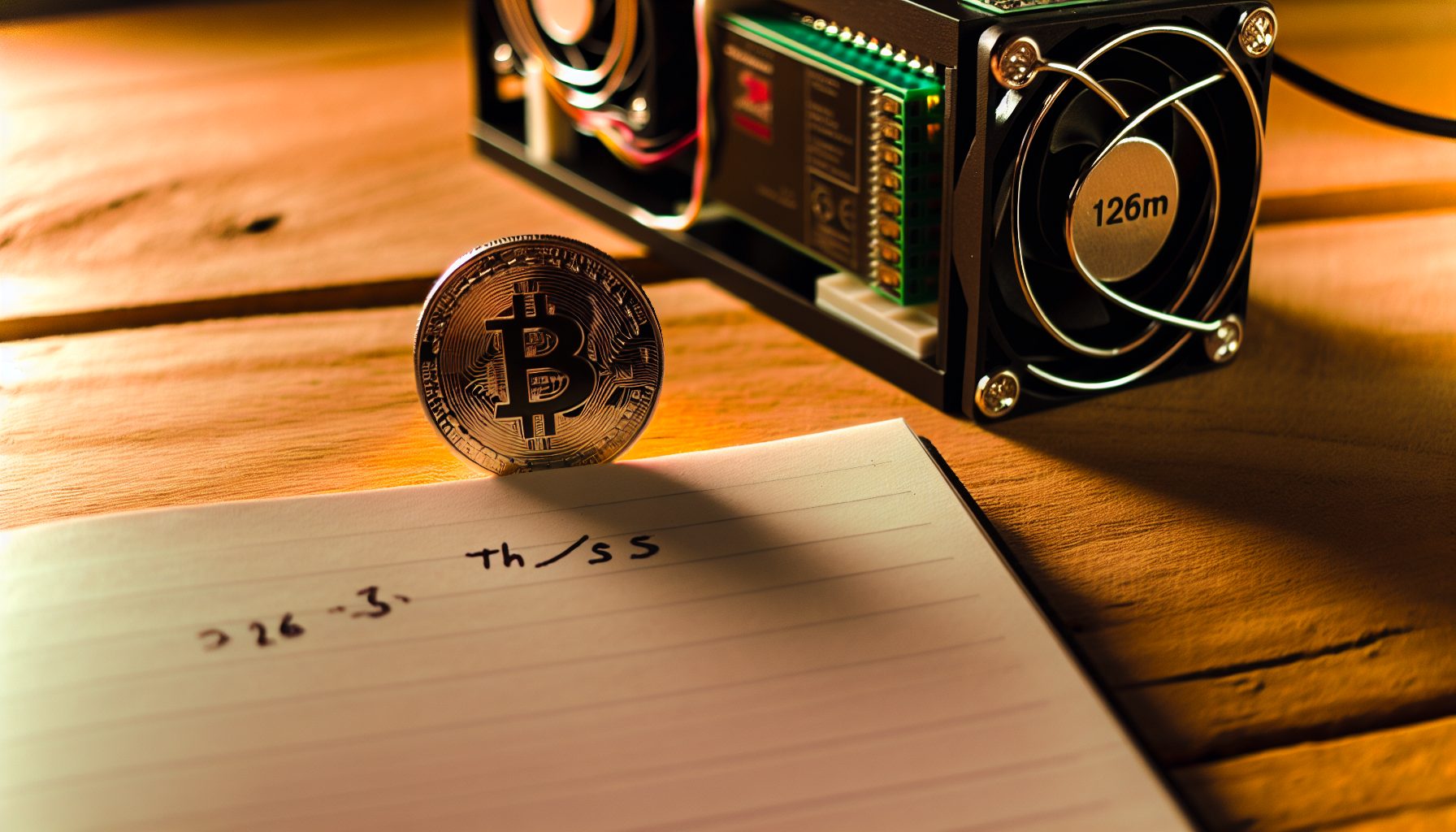
Look, I’m gonna be straight with you about the Whatsminer M50S. When I first saw the specs — 126 TH/s for Bitcoin mining — my brain immediately went “okay, but what are my ACTUAL chances of solo mining a block with that?”
Because here’s the thing about solo mining Bitcoin with ASICs: the math gets brutal really fast.
I spent like three weeks calculating probabilities, comparing it to other miners in the same price range, and honestly? The M50S is a solid machine, but whether it makes sense for solo mining depends entirely on how you think about odds and what you’re trying to accomplish.
This isn’t one of those reviews where I pretend every miner is “perfect for solo mining!” — some are okay, some are really good for specific situations, and some honestly make more sense in a pool. Let me break down exactly where the M50S fits.
Whatsminer M50S Specs: The Raw Numbers for Solo Bitcoin Mining
First, let’s talk about what you’re actually getting with the M50S:
- Hashrate: 126 TH/s (±5% depending on firmware)
- Power consumption: 3276W at the wall
- Efficiency: 26 J/TH
- Noise level: Around 75 dB (it’s LOUD, trust me)
- Cooling: Dual-fan design, needs serious ventilation
- Algorithm: SHA-256 (Bitcoin only, no altcoin switching)
That efficiency number is pretty important. At 26 J/TH, it’s not the most efficient Bitcoin miner out there — the newer Antminer S21 hits like 17.5 J/TH — but it’s also not total garbage. It’s middle-of-the-pack, which matters a lot when you’re paying electricity bills month after month with zero guaranteed return.
The cool part is: MicroBT (the company behind Whatsminer) builds really solid hardware. I’ve talked to people running M30S units from 2026 that still work fine. That reliability matters more in solo mining than people think, because you need consistent uptime.
Power Draw Reality Check
3276W is no joke. That’s like running 32 gaming PCs at full load, all the time. Before you even think about Whatsminer solo mining Bitcoin, calculate your power cost:
- At $0.10/kWh: $235/month
- At $0.15/kWh: $353/month
- At $0.20/kWh: $471/month (honestly don’t solo mine at this rate)
I’m lucky because my dad lets me use garage power for my mining experiments, but if you’re paying market rates, that power bill hits BEFORE you find any blocks. That’s the harsh reality of ASIC solo mining — and here’s what’s critical to understand: those electricity costs are guaranteed and ongoing every single month, while block rewards remain highly speculative and might never materialize.
Solo Mining Bitcoin Odds with 126 TH/s: The Brutal Math
Okay, here’s where I show you the actual probability calculations that made me rethink everything.
Bitcoin network hashrate right now is around 600 EH/s (that’s 600,000,000 TH/s). The M50S contributes 126 TH/s to that massive pool of computing power. Your share of the network?
0.000021% of total hashrate.
Bitcoin finds a block every 10 minutes on average (144 blocks per day). With 126 TH/s, your chances of finding one of those blocks is approximately:
- One block every 11.6 years (statistically speaking)
- That’s 0.086 blocks per year
- Or about 8.6% chance of hitting one block in any 12-month period
What I wish I knew earlier: that “one block every 11.6 years” number is an AVERAGE. You could hit a block next week, or you could run for 20 years and never find one. That’s how probability works. It’s not a guarantee or a schedule — it’s a lottery where you hold a really, really tiny percentage of all possible tickets.
For comparison, check out my solo mining probability chart to see how different hashrates stack up against various coins.
What Does “Finding a Block” Actually Mean?
If you somehow beat those odds and the M50S finds a Bitcoin block, you’d receive the current block reward (3.125 BTC after the 2026 halving) plus transaction fees (usually 0.1-0.5 BTC extra).
At current prices ($73,850 per BTC), that’s roughly $195,000-$220,000 in one shot.
That’s the dream, right? That’s why solo mining Bitcoin feels like the ultimate crypto lottery ticket.
My Honest Take: Is the M50S Worth It for Solo Mining?
Here’s where I actually give you my real opinion instead of just listing specs.
The Whatsminer M50S is a solid mid-tier ASIC, but for solo mining Bitcoin specifically? It’s in this weird middle zone where it’s technically capable but statistically frustrating.
What the M50S Does Well
- Build quality: MicroBT makes tough hardware that runs stable for years
- Firmware options: You can underclock to save power during high-rate periods
- Available hashrate: 126 TH/s is enough to “play the lottery” — you DO have a real (if tiny) chance
- No pool fees: Every satoshi you find is 100% yours
Where It Falls Short
- Not enough hashrate for decent odds: 11.6 years average wait time is ROUGH
- Power efficiency: At 26 J/TH, you’re burning money faster than more efficient miners
- Noise level: 75 dB means you need a garage, shed, or dedicated mining space
- Cost vs. probability: If you’re spending $2,800-$3,500 on the miner, then $235+/month on power, the ROI math gets really challenging
Trust me on this: if you have exactly one M50S and you’re solo mining Bitcoin with it, you’re essentially buying expensive lottery tickets every single day. It’s technically possible to win, but the odds are against you in a major way.
Better Alternatives for Solo Mining (And When the M50S Makes Sense)
Okay, so if 126 TH/s isn’t quite enough for comfortable Bitcoin solo mining odds, what ARE the alternatives?
Option 1: More Hashrate (If You Can Afford It)
The honest answer is that Bitcoin solo mining really needs 500+ TH/s to start feeling somewhat reasonable (you’d get to around one block every 3 years statistically). Some miners stack multiple units:
- 4x Whatsminer M50S = 504 TH/s = ~2.85 years per block average
- 4x Antminer S19 XP = 560 TH/s = ~2.57 years per block average
But now you’re looking at $12,000+ upfront and $940+/month in electricity (at $0.10/kWh). That’s a serious commitment.
Check out my Antminer S19 XP solo mining review for another perspective on mid-tier ASICs.
Option 2: Solo Mine Easier Coins
Here’s what I actually do: I use lower-hashrate hardware to solo mine coins where I have REALISTIC odds of finding blocks.
The M50S is SHA-256 only, so you’re locked into Bitcoin and maybe Bitcoin Cash. But if you’re willing to consider other hardware:
166 TH/s for Kaspa mining, way better solo odds than Bitcoin. Lower power draw (3200W) and you might actually hit blocks. I wrote a full review that breaks down the probability math.
See my Goldshell KA3 solo mining review for detailed Kaspa block odds. Spoiler: they’re WAY better than Bitcoin.
Option 3: The “Lottery Ticket” Approach (What I Recommend)
If you specifically want to solo mine Bitcoin and you understand you’re playing an extreme long shot, then the M50S can make sense in this scenario:
- You have cheap power (under $0.08/kWh ideally)
- You’re mining anyway and just pointing one unit at solo instead of a pool
- You treat it like buying lottery tickets — fun, exciting, but not your financial plan
- You’re mentally prepared to possibly never find a block
In that context? Sure, the M50S works. It’s running Bitcoin Core, validating the blockchain, participating in the network decentralization, and hey — you COULD get lucky.
Option 4: Hybrid Strategy (Pool + Solo)
Something I’ve seen people do that’s pretty smart: run most of your hashrate in a pool for consistent payouts, but point one miner at solo mining for the “what if” factor.
Like if you had 3x M50S units:
- 2 units → Mining pool (consistent income, pays the power bill)
- 1 unit → Solo mining (lottery ticket, pure upside)
That way you’re not gambling your entire operation, but you still get that excitement of checking if you hit a block every morning.
Real-World Setup: Running the M50S for Solo Bitcoin Mining
If you DO decide to go ahead with Whatsminer solo mining Bitcoin on the M50S, here’s what the actual setup looks like.
Hardware Requirements
- Power: 240V circuit recommended (it can run on 120V but you’ll need two circuits)
- Network: Wired ethernet, NOT wifi (ASICs need stable connection)
- Cooling: Ambient temp under 95°F, needs exhaust ventilation
- Space: The M50S is roughly 15″ x 6″ x 11″, weighs about 30 lbs
What I wish I knew earlier: test your electrical setup BEFORE you order the miner. I once tried running a borrowed S9 on a circuit that also powered my dad’s garage tools and it kept tripping the breaker. Not fun.
Software Setup for Solo Mining
You have two main paths for actually solo mining with the M50S:
Method 1: Point directly to Bitcoin Core
- Run a full Bitcoin node (requires 500GB+ storage, takes days to sync)
- Configure bitcoin.conf for mining connections
- Point M50S to your node’s IP address
This is the “pure” solo mining approach. You’re completely independent, validating everything yourself. But it requires technical knowledge and a separate computer running 24/7.
Method 2: Use a solo mining pool service
Services like Public-Pool.io or solo.ckpool.org let you point your ASIC at their infrastructure, but if YOU find a block, YOU get the full reward (they take a tiny 0.5-1% fee).
This is way easier to set up — you just enter the pool address and your Bitcoin wallet in the M50S interface. That’s what I’d recommend if you’re not super technical.
Monitoring Your Solo Mining Attempt
Here’s the thing about solo mining Bitcoin: most days, nothing happens. Your miner hums along, submits shares, but finds nothing.
You’ll want to monitor:
- Uptime (every minute offline is missed chances)
- Hashrate stability (the M50S should hold steady at 125-127 TH/s)
- Temperature (keep it under 75°C for long-term health)
- Power consumption (watch for efficiency drops that indicate hardware issues)
The cool part is: one morning you might wake up, check your wallet, and see 3.125 BTC sitting there. That’s the dream that keeps solo miners going.
Power Cost vs. Block Reward: The Long-Term Economics
Let me show you the actual numbers over different time periods, because this is where the M50S solo mining plan either makes sense or falls apart.
Scenario 1: You Find a Block in Year 1 (Lucky!)
- Hardware cost: ~$3,200
- Electricity (12 months at $0.10/kWh): $2,820
- Total invested: $6,020
- Block reward at current prices: ~$195,000
- Net profit: ~$189,000
Obviously this would be AMAZING. That’s the fantasy scenario.
Scenario 2: You Find a Block at Statistical Average (11.6 Years)
- Hardware cost: $3,200
- Electricity (11.6 years at $0.10/kWh): $32,712
- Total invested: $35,912
- Block reward in 11.6 years: ??? (Bitcoin price is wildly unpredictable)
If Bitcoin goes to $500K in that time, you’d make massive profit. If it drops to $20K, you’d lose money. That uncertainty is brutal.
Scenario 3: You Never Find a Block (Unlucky But Possible)
- Run for 5 years (reasonable ASIC lifespan)
- Hardware cost: $3,200
- Electricity (5 years): $14,100
- Total invested: $17,300
- Return: $0
This is the risk. With solo mining, zero returns is absolutely a possible outcome. Remember: you’re paying those electricity costs every single month regardless of whether you ever find a block — that’s a guaranteed expense against a highly speculative potential reward.
Compare that to pool mining the same hardware, which would generate around 0.0003 BTC per day ($18/day at current prices), or $32,850 over 5 years before power costs.
Stay Away From: When the M50S Is NOT Right for Solo Mining
Okay, here’s where I tell you the situations where buying an M50S for solo mining would be kind of a bad idea:
❌ If Your Power Is Over $0.15/kWh
At 26 J/TH efficiency, high electricity costs kill your economics. You’d be spending $353+/month with single-digit percentage annual block odds. That’s not sustainable.
❌ If This Is Your Only Mining Hardware
Don’t put all your eggs in the “find one massive block” basket. If the M50S is your only miner, you’re looking at years of power bills with probable zero return. Start with something smaller, or do the hybrid pool/solo strategy.
❌ If You Can’t Handle Years of Zero Returns
Solo mining Bitcoin requires a specific mindset. If watching money go out every month with nothing coming in will stress you out (totally fair!), then solo mining psychology might not be for you. Pool mining provides regular dopamine hits of small payouts.
❌ If You Don’t Have Proper Cooling/Ventilation
The M50S is seriously loud at 75 dB and needs proper airflow to avoid overheating. You need a dedicated space like a garage, basement, or shed with proper exhaust setup — not a bedroom or small apartment where noise complaints and heat buildup will be constant problems.
❌ If You’re Expecting Guaranteed ROI
This isn’t a savings account. Solo mining is speculation, gambling, lottery-ticket-buying — whatever you want to call it. If you absolutely need positive ROI, stick to pool mining or don’t mine at all.
Comparison: M50S vs. Other Solo Mining Options
Let me quickly compare the M50S to some alternatives I’ve researched or used.
Whatsminer M50S vs. Antminer S19 XP (140 TH/s)
The S19 XP has slightly more hashrate (140 vs. 126 TH/s) and better efficiency (21.5 vs. 26 J/TH). For solo mining, that extra 14 TH/s cuts your average block time from 11.6 years to 10.4 years. Marginal improvement, but the S19 XP also costs more.
Verdict: If you can get the M50S cheaper, it’s pretty close. The S19 XP is technically better but not by a huge margin for solo purposes.
Whatsminer M50S vs. Multiple S9s (13.5 TH/s each)
You’d need about 9x S9s to match one M50S hashrate. Total power draw would be like 12,000W vs. 3,276W. The power cost alone makes the M50S way better.
Verdict: The M50S wins easily. Older-gen ASICs are not practical for Bitcoin mining anymore.
Whatsminer M50S vs. FutureBit Apollo (Lottery Miner)
The FutureBit Apollo is designed specifically for solo mining hobbyists. It only does 6 TH/s, so your block odds are basically non-existent (one block every 244 years statistically), BUT it’s quiet, low-power, and runs a full node.
Verdict: Completely different use cases. Apollo is for learning and supporting the network. M50S is for actually trying to find blocks.
Whatsminer M50S vs. Solo Mining Kaspa with Goldshell KA3
This is where it gets interesting. The KA3 for Kaspa has way, way better solo mining odds because the Kaspa network is smaller.
With the KA3, you’re looking at roughly one block every 2-4 months (depending on network growth). That’s DRAMATICALLY better than Bitcoin’s 11.6 years with the M50S.
Verdict: If you care about actually finding blocks regularly, Kaspa solo mining wins. If you specifically want the thrill of Bitcoin solo mining, stick with the M50S.
My Final Recommendation: Should You Buy the M50S for Solo Mining?
Alright, here’s my actual advice after running all these numbers and thinking about it from every angle.
Buy the Whatsminer M50S for solo mining Bitcoin IF:
- You have power under $0.10/kWh (ideally $0.08 or less)
- You can afford to run it for years with possible zero return
- You already have other miners earning pool payouts to cover costs
- You think solo mining is FUN and you’re playing the ultimate lottery
- You believe Bitcoin price will increase substantially (making future blocks worth more)
Don’t buy it for solo mining IF:
- This would be your only miner
- Your power is expensive
- You need steady income from mining
- You’d be constantly stressed about the lack of returns
- You haven’t done the math on long-term power costs
Personally? If I had $3,200 to spend on solo mining equipment, I’d probably get the Goldshell KA3 for Kaspa instead. Better odds, still exciting, actually might hit blocks within a reasonable timeframe.
But I totally get the appeal of Bitcoin solo mining. There’s something pure about it — you’re participating in the actual Bitcoin network, validating transactions, and holding that tiny chance at a massive payday. The M50S gives you legitimate (if small) odds at making that happen.
126 TH/s Bitcoin ASIC with solid build quality and decent efficiency. Best suited for miners with cheap power who want to take a shot at solo mining Bitcoin. Long block times statistically, but you DO have real odds.
FAQ: Whatsminer M50S Solo Mining Questions
How long would it take to find a Bitcoin block with a Whatsminer M50S?
Statistically, around 11.6 years on average. But that’s probability, not a guarantee. You could find one next month (0.7% chance), or you could run for 20+ years and never find one. With 126 TH/s against Bitcoin’s ~600 EH/s network hashrate, you control roughly 0.000021% of the network, which translates to about an 8.6% chance of finding one block per year.
Is the M50S profitable for solo mining at current Bitcoin prices?
It depends entirely on whether you find a block. If you find one in year one, you’d make around $189,000 profit (after hardware and power costs). If you never find one, you’d lose all your power costs plus hardware investment. At $0.10/kWh power, you’re spending about $235/month to keep running. Pool mining the same hardware would generate steady but much smaller returns (~$540/month gross before power).
Can I solo mine other coins with the Whatsminer M50S besides Bitcoin?
The M50S is SHA-256 only, so your options are Bitcoin, Bitcoin Cash, and a few smaller SHA-256 coins. You can’t mine Ethereum, Kaspa, Litecoin, or other algorithms. Bitcoin Cash has lower network hashrate than Bitcoin, which would improve your block odds to maybe one block every 2-3 years statistically, but BCH block rewards are worth much less than BTC.
What’s better for solo mining: one M50S or multiple smaller ASICs?
For Bitcoin specifically, hashrate is hashrate — 126 TH/s from one M50S is the same probability-wise as 126 TH/s from multiple smaller units. But one unit is simpler to manage, uses less total power (newer tech is more efficient), generates less heat and noise than multiple old miners, and has one point of failure instead of several. Multiple units only make sense if you’re getting old hardware super cheap.
Should I solo mine with the M50S or just join a pool?
Pool mining with the M50S would generate approximately 0.0003 BTC per day (around $18/day at current prices), or about $540/month before power costs. After $235/month power at $0.10/kWh, you’d net around $305/month consistently. Solo mining gives you a tiny chance at $195,000+ but probable returns of $0. If you need income, choose pool mining. If you want the thrill and can afford the risk, try solo mining. Or do both simultaneously with multiple units.